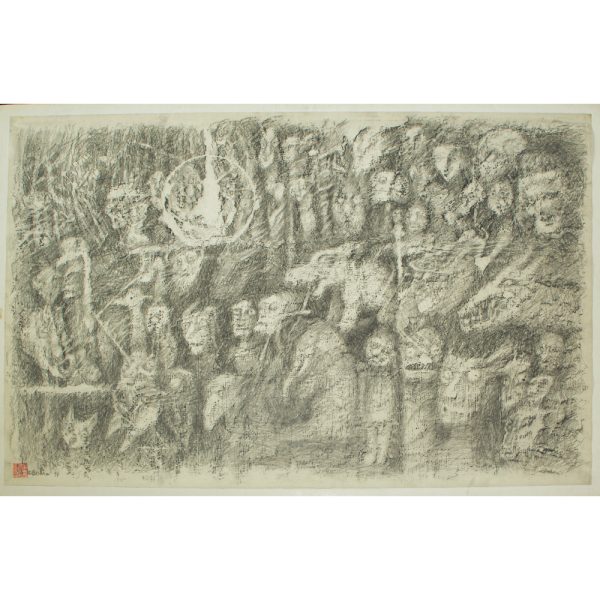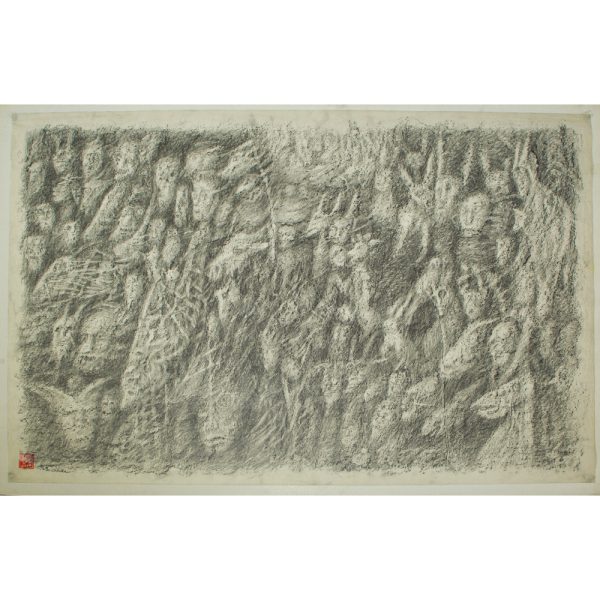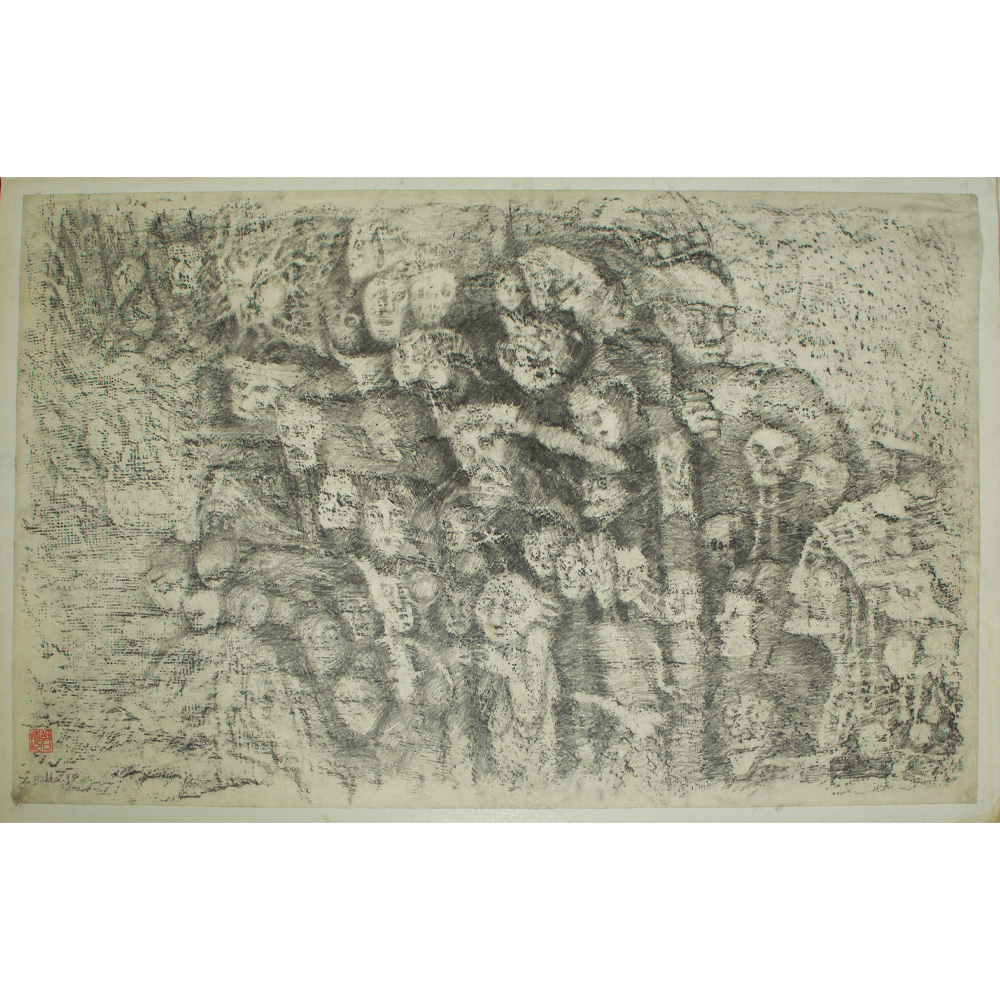
Whoever comes here sits down together, not being afraid of how much to receive, Magical power turns to something less into a lot, Will the virtuous elders kindly give alms equally to every wandering souls
3.165,00€ (VAT included)
Art Style: Pencil lead on Silk paper
Dimensions: 65x100cm 25.6×39.4in
Reference: TB001
1 in stock
Description
Description
This artwork by To Bich Hai, titled Whoever comes here sits down together, not being afraid of how much to receive, Magical power turns to something less into a lot, Will the virtuous elders kindly give alms equally to every wandering souls is an evocative piece created using pencil lead on silk paper, measuring 65 by 100 cm (25.6 by 39.4 inches). The composition is a haunting tableau of faces and figures that seem to merge and emerge from the surrounding space, forming an ethereal, almost otherworldly gathering. These figures seem to float in a communal liminal space, quietly interacting with each other in an atmosphere imbued with spiritual energy.
The central message of the piece, reinforced by the title, speaks to a philosophy of equality and generosity, where all souls, regardless of their wandering nature, come together to receive alms or wisdom. The accompanying text suggests a contemplation of how much each individual receives, how “magical power turns something less into a lot,” and how virtuous elders might dispense kindness equally to all.
The intricate pencil work on the delicate silk surface gives the artwork a sense of fragility and depth. The faces, some more defined than others, blend into a tapestry of ghostly forms, reinforcing the idea that these souls may be both forgotten and remembered, wandering through a space where time seems to stand still. The use of pencil on silk creates an effect of translucency, as if the figures are peering through a thin veil separating the viewer from their world.
The essence of To Bich Hai’s approach can be linked to the artist’s broader reflections on empreinte (imprint). The idea of leaving traces, of recording the subtle imprints of time, resonates deeply in this artwork. The figures in this composition echo the metaphor of a stone wall, where time leaves its marks—whether through love, anger, or fleeting moments of existence. Just as the marks of an ancient stone wall reveal the passage of time and the stories of those who came before, the figures in the artwork seem to embody the emotional and spiritual imprints of the past.
The artist’s philosophy of “frottage”—the act of capturing the imprint of a surface by rubbing it with paper, much like taking the fingerprint of time itself—translates well to the visual language in this piece. The ghostly figures can be seen as the imprint of countless souls who have passed through this communal space. These “traces of souls,” much like the marks left on an ancient stone, carry stories, emotions, and histories that merge together into a larger, collective memory.
As the artist describes, these imprints invite us to look beyond the surface: “What exists behind this face full of scratches? What is the first imprint, from the dawn of time, since the creation of its material?” In this artwork, the viewer is encouraged to uncover the hidden layers of meaning and memory that lie beneath the surface. The figures may represent the enduring presence of those who have inhabited or still inhabit this liminal space, quietly revealing themselves to the attentive observer.
In conclusion, whoever comes here sits down together… is a powerful meditation on time, memory, and the quiet communal spaces that souls share. The delicate medium of pencil on silk echoes the transient nature of existence, while the densely packed figures remind us of the weight of history and the collective imprints left behind by countless lives. This work invites contemplation of the traces we leave and the imprints we encounter, both physical and metaphysical.
“Work on the imprint (since 1989)
Look at the wall of a building, or the stones that support churches and cathedrals. If out of curiosity, one lingers there, and takes the time to observe, one notices, from this well-squared stone, the tool marks of a worker from a bygone era.
Conscientious of his work, from a raw stone, he offers us a flat surface, a mirror ready to receive.
Over time, centuries, other passersby leave their mark, their scratches. Some whisper their secret loves to the stone, Others shout their passion and despair or, slash the stone with knife strokes to express their anger. Some people wander through arabesques,, just to leave a moment of their life there.
But beyond these traces of soul, what lies behind this face full of scratches? What is the original imprint, since the dawn of time, since the creation of its matter? Who inhabited or still inhabits it?
To capture its imprint, and try to listen and see, one can apply a veil of tissue paper on this stone, and have it embraced through rubbings, as if it were skin.
And if one manages to forget oneself, to surrender, and become the stone, it reveals gradually itself, revealing a weave.
From this weaving of signs, of traces, elaborated over millions of years, it is up to each one to guess, to seek the key, to find the thread that will lead them to the end of the mirror, to the other side of the shore, in order to embroider their own hidden world there.“
More artworks by Tô Bich Hai
-
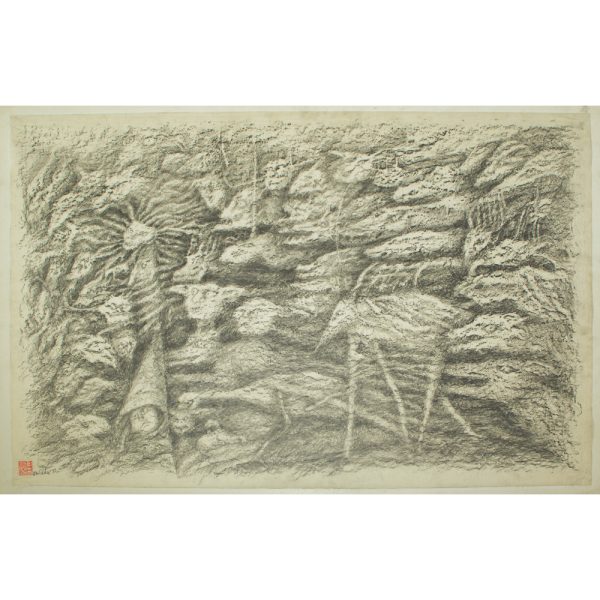
Over there were those planning troop dispositions, rushing themselves to occupy the king’s seals, making an extremely violent fight
Tô Bich Hai
3.165,00€ (VAT included)65x100cm
-
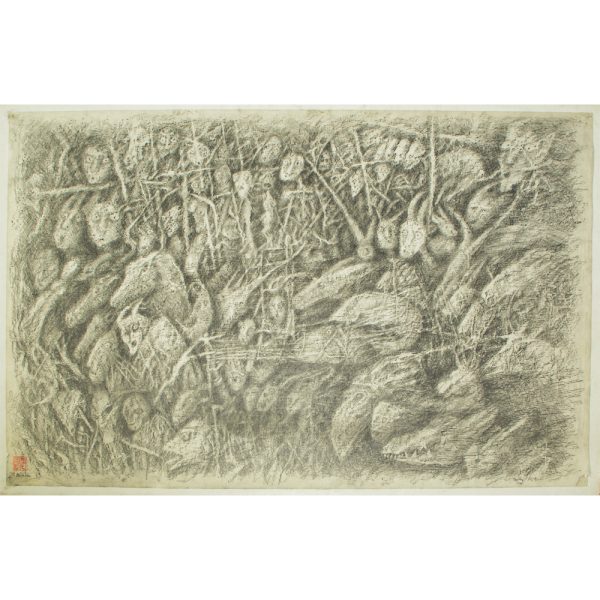
There were people falling down to the sea. Ones killed by wild wolves’ canines of elephant’s ivory
Tô Bich Hai
3.165,00€ (VAT included)65x100cm
-
There were persons often giving birth but not raising. There were also persons suffering a miscarriage, and others living in misery
Tô Bich Hai
3.165,00€ (VAT included)65x100cm
-
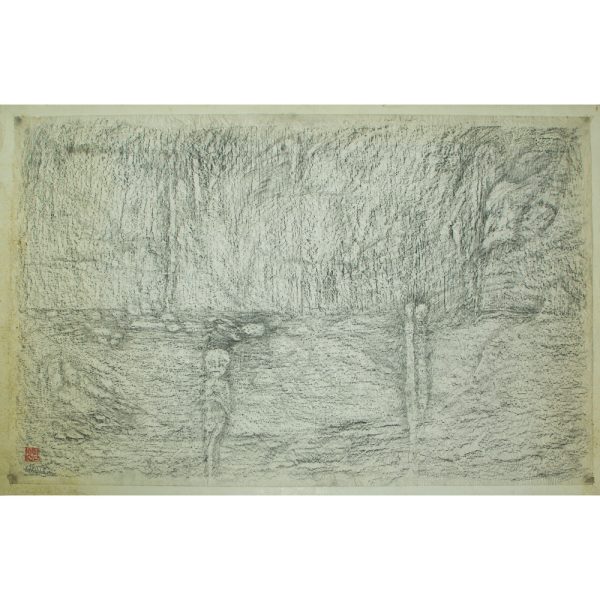
There were souls seeking help in the God temple and the Buddhist pagoda, or at the entrance to the market or at the end of the river
Tô Bich Hai
3.165,00€ (VAT included)65x100cm