
Color and abstract perspective converge to create a visual language that goes beyond representation. Freed from the constraints of literal form, artists use color as a powerful emotional tool and abstraction as a way to reshape reality, offering new ways of seeing and feeling. Through bold palettes, layered compositions, and unexpected contrasts, these elements interact to evoke mood, movement, and meaning—inviting the viewer to interpret each work through their own personal lens.
At MAG The Women Gallery, we believe in the power of color and abstraction to evoke emotion, spark dialogue, and challenge perception. In this new feature, we are proud to present a curated selection of three vibrant, abstract works made by Lily Okamoto, Nicole Monnereau and Malgorzata Martzloff-Kowalczyk. Each piece invites the viewer into a dynamic visual experience, where color becomes language and form transcends convention. Through these works, we continue our commitment to amplifying powerful voices and celebrating art that dares to be felt as much as it is seen.
Carousel by Lily Okamoto:
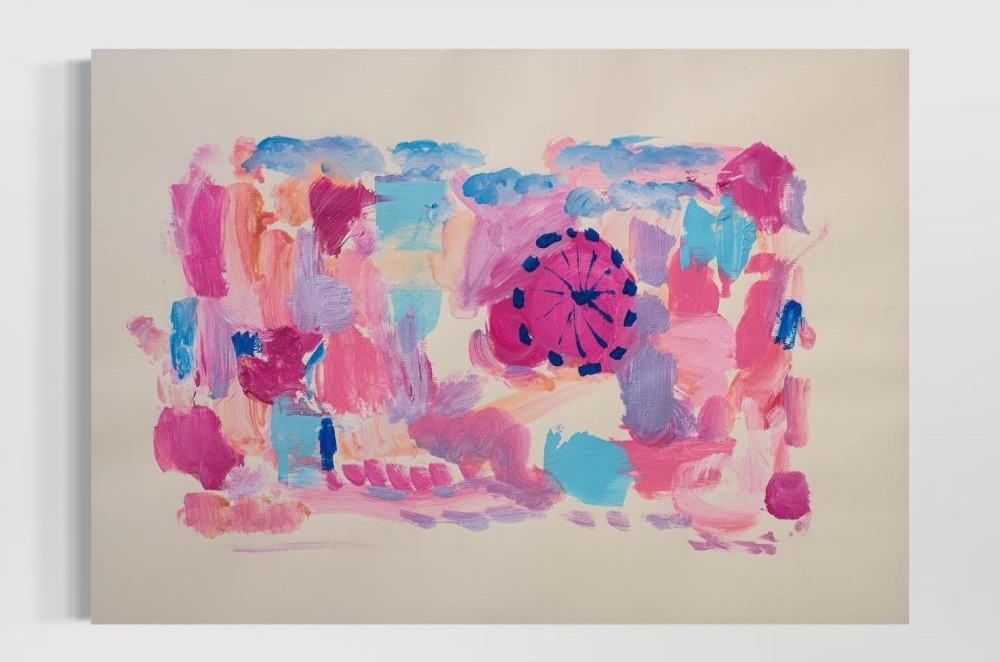
Carousel – Lily Okamoto
Carousel by Lily Okamoto unfolds as a vibrant meditation on movement, memory, and sensory joy. Through its fluid abstraction, the work captures not a literal scene, but the emotional imprint of a fleeting experience—something akin to the exhilaration and gentle disorientation of a carousel ride.
The composition resists rigid structure, instead embracing a spontaneous choreography of brushstrokes that seem to drift, collide, and reassemble across the surface. This visual rhythm mirrors the cyclical motion suggested by the title: a continuous turning where moments blur into one another. The central circular form, subtly emphasized with darker blue marks, acts as both anchor and axis—hinting at rotation while grounding the otherwise free-flowing composition.
Color plays a leading role in shaping the viewer’s experience. The dominance of pinks and magentas evokes warmth, playfulness, and a sense of childlike wonder, while the interjections of cool blues and soft lavenders introduce balance and moments of calm. This dialogue between warm and cool tones creates a pulsating energy, as if the painting itself is breathing—expanding and contracting in waves of intensity.
There is also a compelling tension between opacity and transparency. Some strokes feel dense and immediate, while others appear as soft washes, almost dissolving into the background. This layering suggests depth not just in space, but in time—like overlapping memories or sensations that cannot be fully separated. The viewer is invited to navigate these layers intuitively, discovering their own pathways through the composition.
Ultimately, Carousel operates as an emotional landscape rather than a representational one. It evokes the essence of motion without defining it, allowing each viewer to project their own associations onto its shifting forms. In doing so, Okamoto transforms abstraction into an accessible, immersive experience—one that celebrates the beauty of impermanence, the joy of movement, and the power of color to carry feeling beyond words.
Trace Bleue by Nicole Monnereau:
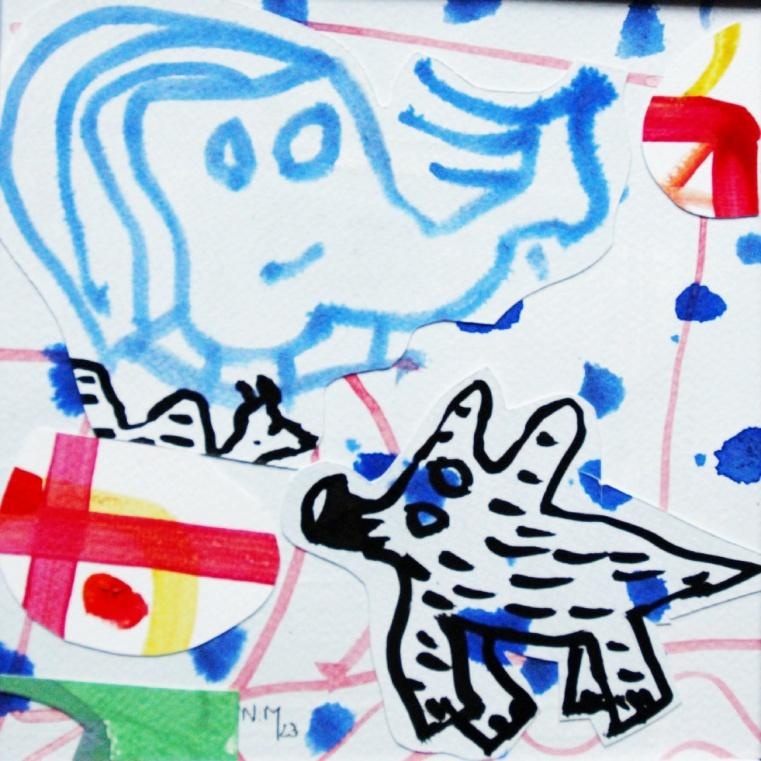
Trace Bleue – Nicole Monnereau
Trace Bleue by Nicole Monnereaureads like a visual playground where instinct, gesture, and imagination converge. The work embraces a language that feels deliberately unrefined—almost childlike in its execution—yet deeply intentional in how its elements interact and coexist. It is within this tension between spontaneity and composition that the piece finds its vitality.
The dominant blue lines, loose and fluid, seem to drift across the surface like traces of thought or memory. They evoke figures without fully defining them—suggesting faces, creatures, or fleeting presences that resist fixed interpretation. This ambiguity invites a kind of active viewing, where the eye continuously searches for meaning, only to find it shifting with each glance.
Layered onto this are cut-out forms that introduce a tactile dimension to the work. These fragments—some outlined in bold black, others filled with vivid color—interrupt and converse with the blue gestures beneath them. The juxtaposition of drawn and assembled elements creates a sense of dialogue: between control and chance, between permanence and play. The collage technique itself reinforces the idea of construction through accumulation, as if the artwork has grown organically, piece by piece.
Color operates here not as harmony, but as punctuation. Bright reds, yellows, and greens emerge in sharp, almost abrupt moments, guiding the viewer’s gaze while amplifying the composition’s energy. These accents contrast with the softer, more fluid blue marks, creating a push and pull between structure and freedom.
What is particularly striking is the way the piece negotiates space. Despite its compact format, Trace bleue feels expansive—its elements arranged in a way that suggests movement beyond the edges of the paper. The figures appear to enter and exit the frame, reinforcing a sense of continuity and openness.
Ultimately, Monnereau’s work invites us to reconnect with a more intuitive way of seeing. It bypasses rigid interpretation in favor of curiosity and imagination, encouraging the viewer to embrace ambiguity and to find joy in the act of looking. In Trace bleue, abstraction becomes a form of visual storytelling—one that is playful, fragmented, and endlessly open to reinvention.
Les conflits intérieurs by Malgorzata Martzloff-Kowalcyk:
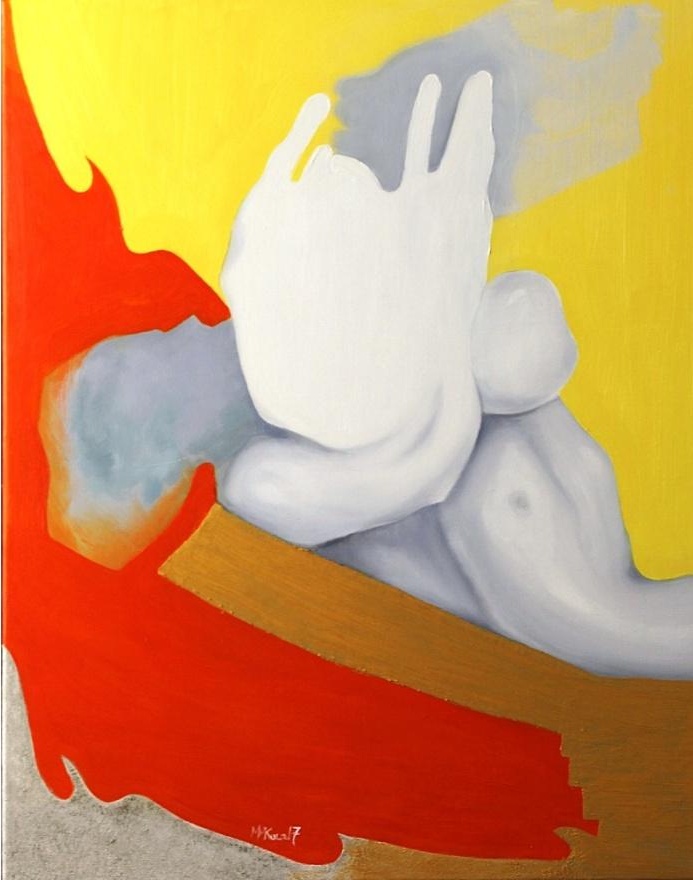
Les conflits intérieurs – Malgorzata Martzloff – Kowalcyk
Les conflits intérieurs by Malgorzata Martzloff-Kowalcyk presents a striking visual tension between form, color, and emotional state—an intimate portrayal of inner struggle rendered through a bold, almost symbolic abstraction of the human body.
At the center of the composition, a pale, sculptural figure appears curled into itself, its posture protective, almost defensive. The gesture of the hand—raised and partially obscuring the face—suggests withdrawal, resistance, or perhaps an attempt to shield oneself from an external force that is never fully defined. This ambiguity is key: the conflict implied is not outwardly visible, but deeply internal, psychological, and unresolved.
The body, painted in soft gradients of grey and white, contrasts sharply with the surrounding fields of intense color. This muted treatment gives the figure a sense of vulnerability and fragility, as if it exists in a suspended, introspective state. In opposition, the vivid yellow background radiates an almost oppressive brightness—suggestive of exposure, tension, or overwhelming clarity. It does not comfort; it confronts.
Cutting across the composition, a bold swath of red introduces a visceral, almost aggressive energy. Its fluid, flame-like form feels intrusive, as though it is encroaching upon the figure’s space or erupting from within it. This red can be read as emotion in its rawest state—anger, anxiety, or passion—disrupting the stillness of the body and intensifying the sense of conflict.
A band of ochre grounds the composition diagonally, acting as both support and division. It anchors the figure physically, yet also reinforces the fragmentation of the pictorial space, echoing the fractured emotional landscape being depicted.
What is particularly compelling is how the painting balances figuration and abstraction. While the human form is recognizable, it is simplified and stylized, allowing it to operate less as a specific individual and more as a universal embodiment of internal tension. The surrounding abstract elements do not describe a setting, but rather a psychological environment—one shaped by forces that are felt rather than seen.
Les conflits intérieurs becomes a powerful meditation on the complexity of the inner self. It visualizes the invisible: the push and pull between opposing emotions, the coexistence of vulnerability and intensity, and the silent battles that unfold beneath the surface. Through its bold contrasts and restrained figuration, the work invites the viewer not just to observe, but to recognize something of their own internal landscape within it.
Stay tuned for upcoming features on our blog, and explore our collections and latest series exclusively at MAG The Women Gallery.
Sources:
https://www.magthewomengallery.com/artists/lily-okamoto
https://www.magthewomengallery.com/artists/nicole-monnereau
https://www.magthewomengallery.com/artists/malgorzata-martzloff-kowalczyk