
Acrylic is one of the most widely recognized techniques in painting, but that does not necessarily make it one of the easiest, especially when the compositions move into the realm of abstraction. At MAG The Women Gallery, we explore three acrylic artworks made by Lily Okamoto and Alexandra Roussopoulos, whose practices demonstrate the expressive possibilities of the médium.
Working with acrylic requires a careful balance between spontaneity and control, where layers, textures, and color interactions must be thoughtfully orchestrated to create depth and meaning.
In abstract compositions, this challenge becomes even more pronounced. Without the guidance of figurative forms, artists rely on gesture, rhythm, and chromatic relationships to construct visual narratives that resonate with the viewer.
Trough their distinct approaches, these artists transform acrylic into a space for experimentation, movement, and emotional resonance, revealing how abstraction can become a powerful language in contemporary painting.
Where Things Refuse to Settle from by Lily Okamoto:
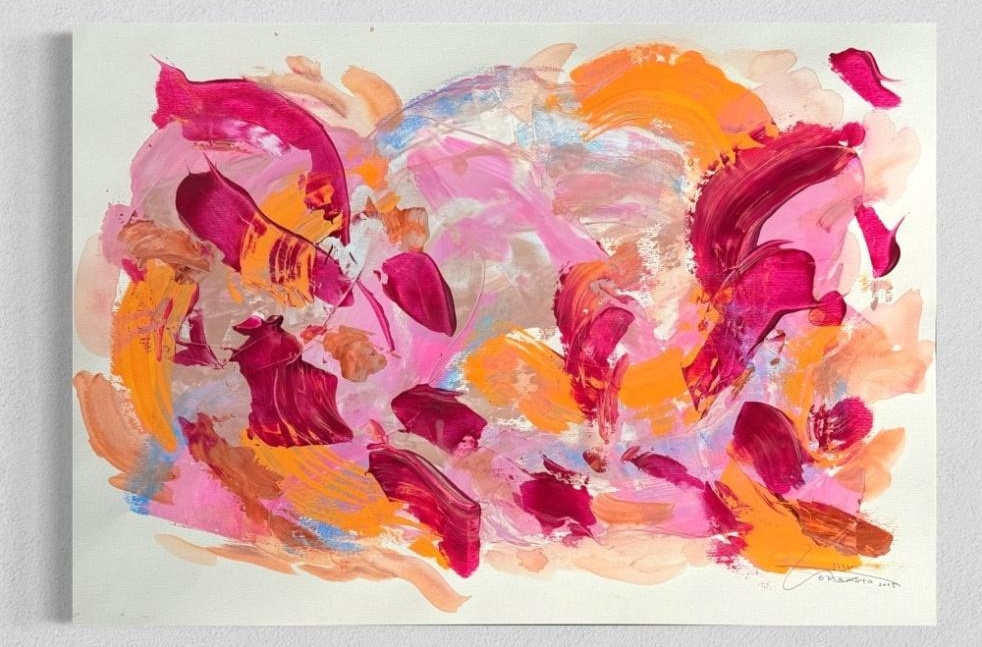
This abstract acrylic composition unfolds through a vibrant interplay of gesture, color, and layered transparency, creating a painting that feels both energetic and fluid.
Rather than organizing the image around a fixed focal point, “Where things refuse to settle” constructs the composition through sweeping, curved movements that guide the viewer’s eye across the surface. These gestural marks generate a sense of rhythm and motion, as if the forms are unfolding or drifting within the pictorial space.
Color plays a central role in shaping the emotional atmosphere of the work. A luminous palette of magenta, coral pink, and vibrant orange dominates the composition, punctuated by softer beige tones and subtle hints of blue. The deeper magenta strokes anchor the painting visually, providing moments of intensity and structure, while the lighter washes introduce openness and breath within the composition. This contrast between saturated color and translucent layers creates a dynamic balance between energy and harmony.
The acrylic medium allows the artist to explore a range of textures and levels of opacity. Some strokes appear thick and assertive, applied with confident gestural movement, while others are diluted into airy washes that reveal the layers beneath. This layering technique enhances the sense of depth and spontaneity, suggesting a process that embraces both intuition and deliberate compositional control.
Although the painting remains firmly within the language of abstraction, certain forms evoke fleeting organic associations—petal-like shapes, fragments of movement, or natural rhythms. Yet these references never fully resolve into recognizable imagery, leaving space for the viewer’s imagination to engage freely with the work.
Ultimately, the painting becomes an exploration of movement, emotion, and chromatic dialogue. Through its expressive brushwork and vibrant palette, Lily Okamoto demonstrates how acrylic—often perceived as a straightforward medium—can be transformed into a powerful tool for experimentation and visual storytelling.
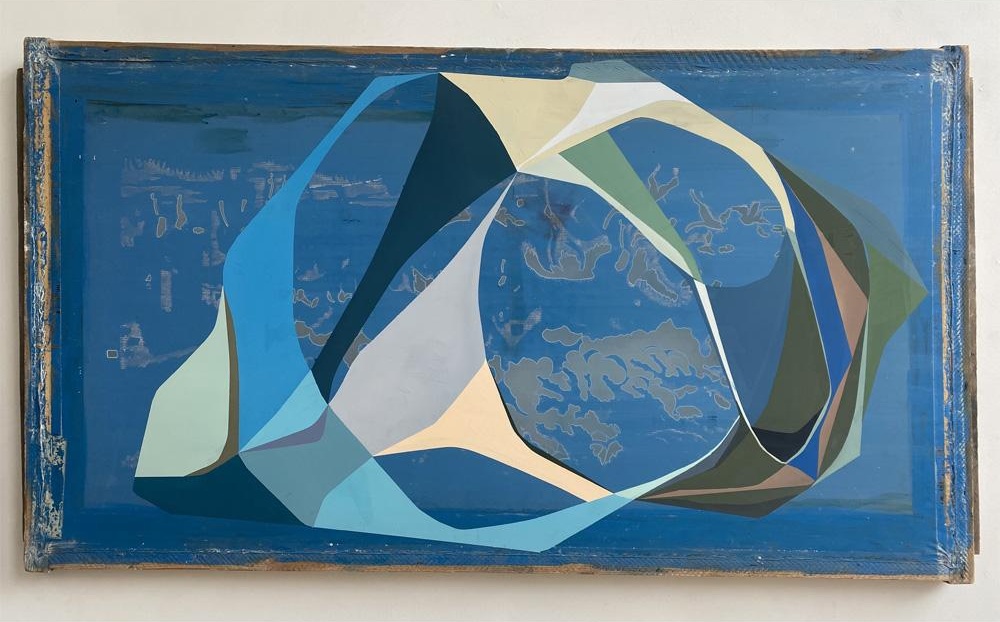
Volante IX by Alexandra Roussopoulos:
This acrylic composition explores abstraction through a language of geometry, structure, and spatial tension.
At the center of the work, a dynamic arrangement of angular planes unfolds across the surface, forming a faceted structure that appears both solid and fluid. The interconnected shapes bend and fold into one another, creating the impression of a suspended form—almost like a ribbon or sculptural object moving through space.
The painting’s chromatic palette is restrained yet sophisticated, dominated by variations of blue that establish a calm and atmospheric background. Against this field, the geometric planes introduce a carefully balanced combination of muted greens, soft creams, deep teal, and pale neutrals. This contrast allows the central structure to emerge with clarity while maintaining a harmonious visual balance.
One of the most compelling aspects of Alexandra Roussopoulos work is her way to play with dimensionality. Through the careful modulation of color and tonal shifts, the artist creates subtle illusions of depth and volume. Each plane appears to tilt, rotate, or recede, giving the composition a sculptural quality that blurs the boundary between painting and spatial construction.
The background also contributes to the conceptual richness of the piece. Beneath the dominant blue surface, faint markings and textures suggest traces of an underlying layer, almost like a map or memory embedded within the material. These ghost-like patterns introduce a sense of history and process, hinting at the artist’s exploration of time, erasure, and transformation.
Framed within a visibly worn wooden border, the work gains an additional tactile dimension. The distressed frame contrasts with the precision of the geometric forms, reinforcing the dialogue between structure and imperfection, control and material history.
Ultimately, the painting presents abstraction as a spatial investigation. Through its interplay of geometry, layered surfaces, and restrained color, it invites viewers to contemplate how form can occupy and transform pictorial space, turning the canvas into a site where structure, movement, and perception continuously unfold.
Victoire de Samothrace by Lily Okamoto:
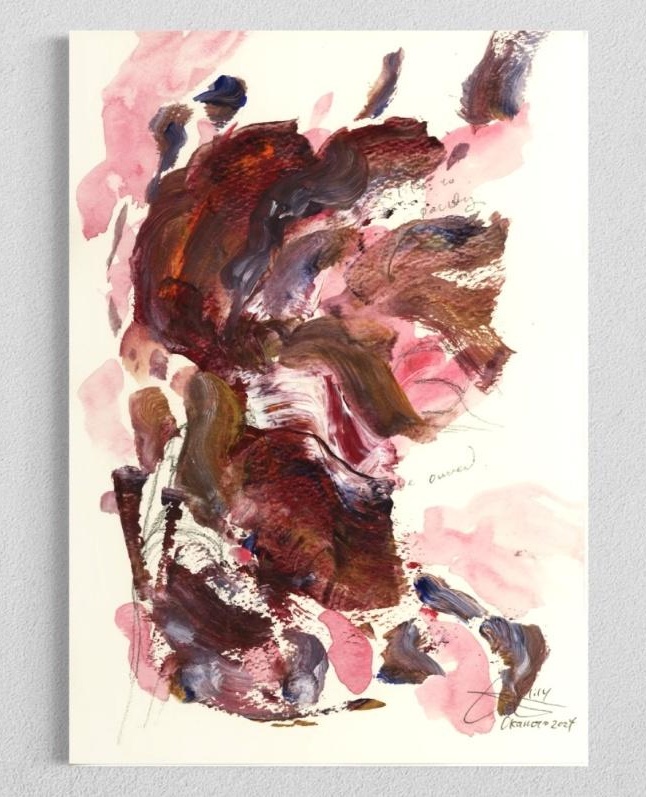
This acrylic composition unfolds through a powerful dialogue between gesture, texture, and emotional intensity. Rather than relying on rigid structure, the painting is driven by expressive brushwork and layered marks that create a sense of movement and immediacy.
The composition appears almost improvisational, allowing the material qualities of the paint to guide the visual rhythm across the surface.
The color palette is rich and atmospheric, dominated by deep reds, earthy browns, and burgundy tones, which are softened by translucent washes of pink. These lighter areas introduce breathing space within the composition, balancing the density of the darker, more saturated brushstrokes. The contrast between these tones creates a dynamic tension that pulls the viewer’s eye through the work.
Texture plays a crucial role in the painting’s visual language. Thick, gestural strokes overlap with diluted passages of acrylic, revealing the versatility of the medium. Some areas appear almost sculptural in their density, while others dissolve into fluid, watercolor-like stains. This interplay between opacity and transparency gives the piece a sense of depth and layered temporality, as if different moments of the creative process remain visible on the surface.
Although the painting remains abstract, the arrangement of the forms subtly evokes the suggestion of a figure in motion. The sweeping central gestures create a vertical momentum that recalls the energy of classical sculpture—an impression reinforced by the title’s reference to the Winged Victory of Samothrace. Rather than depicting the figure directly, the artist captures its essence through movement, fragmentation, and expressive mark-making.
This artwork made by Lily Okamoto becomes an exploration of gesture as a carrier of emotion and memory. Through its raw textures and evocative palette, the painting transforms acrylic into a medium capable of conveying both physical energy and poetic abstraction, inviting viewers to experience the work as a moment of movement suspended in paint.
Stay tuned for upcoming features on our blog, and explore our collections and latest series exclusively at MAG The Women Gallery.
Sources:
https://www.magthewomengallery.com/product/volante-ix-2021/
https://www.magthewomengallery.com/product/where-things-refuse-to-settle-from/
https://www.magthewomengallery.com/product/victoire-de-samothrace/